Why Standing Pelvic Floor Exercises Matter for Prolapse
Most pelvic floor exercise programs focus on lying down or seated positions, and for good reason — those positions are easier and great for building initial strength. But here is the reality: prolapse symptoms typically occur when you are upright. The heaviness, pressure, and bulging you feel are worst when you are standing, walking, lifting, or going about your daily life.
Standing pelvic floor exercises bridge the gap between building strength in easy positions and having that strength available when you actually need it. By training your pelvic floor against gravity, you develop the functional capacity to support your pelvic organs during the activities that matter most.
The gravity factor: When you stand upright, your pelvic floor muscles must support the weight of your abdominal organs against the full force of gravity. Research shows that intra-abdominal pressure increases by approximately 50% from lying to standing. Training in this upright position is essential for real-world symptom management.
The Benefits of Functional Standing Training
Standing pelvic floor exercises offer several unique advantages that you cannot get from floor-based work alone:
Gravity as a Training Tool
Just as lifting weights builds stronger arms than just moving them through the air, working your pelvic floor against gravity builds functional strength that translates to daily life. Each standing contraction trains your muscles to lift and support under real-world conditions. This specificity of training is a fundamental principle in rehabilitation — your muscles get stronger at the tasks you practice.
Whole-Body Integration
When you stand, your entire body is engaged — your feet, legs, core, and postural muscles all work together. Standing exercises train your pelvic floor to coordinate with this whole-body system. This integrated approach means your pelvic floor learns to activate automatically as part of movement patterns, not just in isolation.
Daily Activity Transfer
The ultimate goal of pelvic floor rehabilitation is not to be great at exercises — it is to function well in daily life. Standing exercises directly mimic the position you are in when you cook, clean, shop, walk, garden, and carry out all the activities that prolapse can make challenging. By training in standing, you are rehearsing the exact functional demands your pelvic floor faces each day.
Daily Integration Tips
- Practice a few standing pelvic floor contractions while waiting for the kettle to boil
- Do a set while brushing your teeth morning and evening
- Engage your pelvic floor before picking up a grocery bag or grandchild
- Practice during your daily walk — contract for five steps, relax for five steps
- Use household tasks as practice opportunities: contract while unloading the dishwasher
Progressing from Lying to Standing
Jumping straight into standing exercises without preparation can be overwhelming for your pelvic floor, especially if you have prolapse. Here is the progression I recommend to my patients:
- Lying Down (Weeks 1-3) — Master your pelvic floor activation, breathing coordination, and basic holds in a gravity-reduced position. This is where you build your brain-muscle connection and learn correct technique
- Seated (Weeks 2-4) — Progress to practicing in a chair, where gravity begins to play a role but your body weight is still supported. This is an intermediate challenge
- Standing Supported (Weeks 3-5) — Begin standing exercises while holding onto a counter or wall for support. This allows you to focus on your pelvic floor without worrying about balance
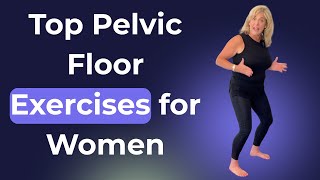
- Standing Unsupported (Weeks 4-6+) — Full standing exercises with movement integration, as demonstrated in this video. This is the functional training phase
These timelines are guidelines, not rigid rules. Some women progress faster, others need more time at each stage. Listen to your body and your symptoms — if standing exercises increase your feeling of heaviness or pressure, spend more time at the previous level before progressing.
Get the Complete Exercise Class
Follow along with the full 1+ hour video class
The Exercises Demonstrated in This Video
The standing exercises in this video are carefully selected to be safe for women with prolapse while still providing meaningful challenge. Each exercise focuses on engaging the pelvic floor during functional movement patterns:
- Standing Pelvic Floor Lifts — Basic contractions in standing with proper posture alignment, building the foundation for all other standing work
- Weight Shifts with Engagement — Shifting your weight from side to side while maintaining pelvic floor activation teaches dynamic stability
- Mini Squats with Pelvic Floor — Shallow squats coordinated with pelvic floor contraction on the rise, mimicking sitting and standing motions
- Standing Hip Abduction — Lifting the leg to the side while maintaining pelvic floor engagement strengthens the hip-pelvic floor connection
- Heel Raises with Lift — Rising onto your toes while engaging your pelvic floor combines calf strengthening with upward pelvic support
Important Note
If you have grade 3 or 4 prolapse, or if you have not yet built a foundation with lying and seated exercises, please work with a pelvic floor physical therapist before attempting standing exercises. These exercises are designed for women who have already developed basic pelvic floor awareness and strength and are ready to progress to functional training.
Frequently Asked Questions
Are standing pelvic floor exercises harder than lying down?
Yes, standing pelvic floor exercises are more challenging because gravity works against your muscles. When you are lying down, gravity is neutral — your pelvic floor does not have to support the weight of your organs against a downward pull. In standing, your pelvic floor must actively resist gravity, making each contraction more demanding. This is why we recommend building a foundation with lying and seated exercises first before progressing to standing work.
Can I do standing pelvic floor exercises with grade 2 prolapse?
Many women with grade 2 prolapse can safely perform standing pelvic floor exercises, but it depends on your individual symptoms and strength level. If you have been doing lying and seated exercises for several weeks and feel comfortable with those, you may be ready to try standing variations. Start with short durations and monitor your symptoms. If you notice increased heaviness or pressure, return to seated exercises and build more strength before trying again. Always consult your pelvic floor therapist for personalized guidance.
How many reps should I do for standing pelvic floor exercises?
Start with 8-10 repetitions of each exercise, performing 2-3 sets. For sustained holds, aim for 5-8 seconds initially and build up to 10-12 seconds over time. Quality is far more important than quantity — 8 well-executed contractions with proper form will benefit you more than 20 poor ones. As your strength improves over weeks and months, you can gradually increase repetitions and hold times.
When should I avoid standing pelvic floor exercises?
Avoid standing exercises if you have severe prolapse without clearance from your healthcare provider, if standing significantly worsens your prolapse symptoms, during the early postpartum period before your pelvic floor has regained basic function, or if you are experiencing acute pelvic pain. On days when your symptoms feel worse than usual, it is perfectly fine to switch to lying or seated exercises instead.
Can I combine standing pelvic floor exercises with wearing a pessary?
Absolutely. Many women find that wearing a pessary during standing exercises provides additional support and comfort, especially in the early stages of their strengthening program. The pessary provides mechanical support while your muscles are building strength. Over time, as your pelvic floor becomes stronger, you may find you need the pessary less during exercises, though this varies for each individual.

Sheree DiBiase
Sheree DiBiase has been a physical therapist for over 40 years, specializing in pelvic floor rehabilitation. She is the founder of Lake City Physical Therapy and the creator of the Pelvic Floor Pro app. Sheree is a pioneer in functional pelvic floor training and has helped thousands of women progress from basic exercises to confident, active lifestyles despite prolapse.