Why Pelvic Floor Exercises Can Make Incontinence Worse
It is one of the most frustrating experiences for women dealing with bladder leakage: you start doing the exercises everyone tells you to do, and your incontinence actually gets worse. Many women at this point give up entirely, concluding that pelvic floor exercises do not work for them and resigning themselves to a leaky bladder for life.
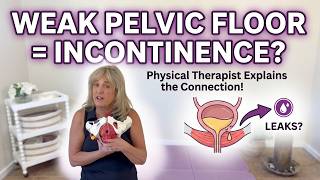
But as Sheree DiBiase explains in the video above, the problem is not that pelvic floor exercises don't work — it's that something mechanical is off. And once you understand what is happening, you can fix it.
The most common reason Kegels backfire is deceptively simple: some of your pelvic floor muscles are already too tight. When you try to strengthen a muscle that is already short and taut, you make it even tighter. And a tighter muscle around the bladder creates the exact opposite of what you need.
The key insight: Your bladder is a hollow organ that needs to fill with urine and then empty completely. It sits inside a container of muscles. If those muscles are too tight, they compress the space the bladder needs to function. Trying to strengthen already-tight muscles further restricts the bladder — and leakage gets worse, not better.
Fitzgerald MP, Kotarinos R. Rehabilitation of the short pelvic floor. I: Background and patient evaluation. Int Urogynecol J. 2003;14(4):261-268. This foundational paper established that pelvic floor muscle overactivity (excessive tightness) is a distinct clinical entity that can worsen with traditional strengthening exercises, and that treatment must address the hypertonic component before strengthening.
Understanding Pelvic Floor Asymmetry
One of the most important concepts Sheree teaches is that the pelvic floor is not flat, and it is not uniform. It has distinct regions that can behave very differently from one another:
- The urogenital triangle (front) — the anterior section of the pelvic floor surrounding the urethra and vaginal opening. This area commonly becomes weakened after childbirth, surgery, or prolonged inactivity.
- The posterior anal triangle (rear) — the back section of the pelvic floor surrounding the anus. This area often becomes excessively tight, especially as a compensatory response to weakness elsewhere.
This asymmetry is the root cause of many exercise failures. When you do a standard Kegel contraction, you contract the entire floor. If the rear is already tight and the front is weak, you end up tightening what is already tight while barely improving what is actually weak. The net result: more tension, more compression on the bladder, and worse symptoms.
Morin M, Bourbonnais D, Gravel D, Dumoulin C, Lemieux MC. Pelvic floor muscle function in continent and stress urinary incontinent women using dynamometric measurements. Neurourol Urodyn. 2004;23(7):668-674. This study demonstrated significant differences in muscle function between different regions of the pelvic floor in women with incontinence, supporting the concept of regional asymmetry as a clinically relevant factor.
Hip Asymmetry Affects the Floor Too
The asymmetry does not stop at the pelvic floor itself. If one hip is tighter than the other or does not move as well, it directly affects the pelvic floor on that side. The obturator internus — a deep hip rotator — passes through the pelvic floor, and restrictions in this muscle pull on the floor unevenly. This is why a comprehensive assessment of hip mobility is essential before prescribing pelvic floor exercises.
Tuttle LJ, Delozier ER, Harter KA, et al. The role of the obturator internus muscle in pelvic floor function. J Women's Health Phys Ther. 2016;40(1):2-9. This paper demonstrated the anatomical and functional connection between the obturator internus and the pelvic floor, showing that hip restrictions directly impact pelvic floor mechanics.
The Diaphragm-Pelvic Floor Connection
Sheree emphasizes another mechanical factor that most women never consider: the diaphragm. Your pelvic floor and diaphragm work together all day, every day. When you breathe in, the diaphragm descends and the pelvic floor should gently descend with it. When you breathe out, both recoil upward together.
If the diaphragm is not moving well — due to chronic tension, poor breathing habits, rib cage restrictions, or postural issues — the pelvic floor cannot move well either. A restricted diaphragm creates a restricted pelvic floor, which means the muscles around the bladder stay tight and do not allow the bladder to fill and empty properly.
This is why you can do Kegel after Kegel and see no improvement: if the diaphragm is not coordinated with the floor, you are training muscles in a dysfunctional pattern.
Talasz H, Kremser C, Kofler M, Kalchschmid E, Lechleitner M, Rudisch A. Phase-locked parallel movement of diaphragm and pelvic floor during breathing and coughing — a dynamic MRI investigation in healthy females. Int Urogynecol J. 2011;22(1):61-68. This MRI study confirmed that the diaphragm and pelvic floor move in synchrony during breathing and coughing, and that disruption to this coordination impairs continence mechanisms.
Get the Complete SUI Class
8 expert-led video sessions covering pelvic floor mechanics, diaphragm coordination & proper training technique
The Short, Tight Muscle Problem
Think of it this way: a healthy muscle should be able to move through its full range of motion — from fully lengthened to fully contracted. When a pelvic floor muscle is chronically short and tight, it is stuck at one end of that range. Trying to contract it further is like trying to make a fist when your hand is already clenched. There is nowhere left to go.
But the problem gets worse when you need to void. For urine to flow out completely, the pelvic floor must relax all the way. A chronically tight muscle cannot fully release. This means:
- The bladder cannot empty completely, leaving residual urine
- Incomplete emptying leads to more frequent urination
- The bladder becomes irritated and overactive
- The cycle of urgency and leakage worsens
When you add strengthening exercises on top of this pattern, you are reinforcing the dysfunction rather than correcting it.
Messelink B, Benson T, Berghmans B, et al. Standardization of terminology of pelvic floor muscle function and dysfunction: report from the Pelvic Floor Clinical Assessment Group of the International Continence Society. Neurourol Urodyn. 2005;24(4):374-380. This ICS standardization paper defined overactive pelvic floor as a condition where muscles do not relax or may paradoxically contract during voiding, leading to voiding dysfunction and worsening incontinence symptoms.
The Solution: Train in Elongated Positions
The answer is not to stop pelvic floor training. As Sheree emphasizes, pelvic floor muscle training with core coordination is the first line of defense for all bladder issues — stress incontinence, urge incontinence, and overactive bladder. The answer is to change how you train.
The key is training in elongated positions — positions that gently stretch the tight areas of the pelvic floor before and during contraction. When you contract a muscle that is on stretch, you teach it to work through its full range of motion rather than reinforcing its shortened position.
What Proper Training Looks Like
- Release first: Address the tight areas of the floor before adding strengthening. This may involve specific positions, manual therapy, or breathing techniques
- Train in length: Practice pelvic floor contractions in positions where the tight muscles are on stretch, so they learn to contract through a full range of motion
- Coordinate with the diaphragm: Ensure your breathing and pelvic floor are working in sync, not fighting each other
- Address hip asymmetry: If one hip is tighter, work on mobility before adding pelvic floor loading on that side
- Integrate the core: Train the pelvic floor together with the deep abdominals, back extensors, and diaphragm as a coordinated unit
Don't Give Up — Get Assessed
If your pelvic floor exercises are making your symptoms worse, do not abandon training altogether. Something mechanical is off, and it can be identified and corrected. A pelvic floor physical therapist or occupational therapist who specializes in pelvic health can assess your specific muscle patterns, identify where the tightness and weakness lies, and create a program that improves your symptoms rather than worsening them. This is what Sheree's SUI class teaches you step by step.
Pelvic Floor Training Is Still the First-Line Treatment
Despite the frustration of exercises making things worse, the clinical evidence is clear: pelvic floor muscle training remains the most effective conservative treatment for urinary incontinence. The difference between success and failure lies not in whether to train, but in how to train.
Properly prescribed pelvic floor rehabilitation addresses all types of incontinence:
- Stress incontinence — leaking when you cough, sneeze, laugh, or exercise
- Urge incontinence — sudden strong urges to void with leakage before reaching the bathroom
- Overactive bladder — excessive frequency, urgency, and nocturia
- Mixed incontinence — a combination of stress and urge symptoms
Dumoulin C, Cacciari LP, Hay-Smith EJC. Pelvic floor muscle training versus no treatment, or inactive control treatments, for urinary incontinence in women. Cochrane Database Syst Rev. 2018;10:CD005187. This landmark review of 31 trials confirmed PFMT as the recommended first-line treatment for SUI, with women 8x more likely to report cure compared to untreated controls.
Bo K. Pelvic floor muscle training in treatment of female stress urinary incontinence, pelvic organ prolapse and sexual dysfunction. World J Urol. 2012;30(4):437-443. This comprehensive review confirmed that supervised, properly prescribed pelvic floor training is effective for all major forms of pelvic floor dysfunction, with the caveat that assessment of muscle function (including overactivity) must precede any strengthening program.
Frequently Asked Questions
Why are my pelvic floor exercises making my incontinence worse?
The most common reason is that some of your pelvic floor muscles are already too tight. When you try to strengthen muscles that are short and taut, you make them even tighter. This restricts the space the bladder needs to fill and empty properly, worsening leakage. Your pelvic floor may also have asymmetry — areas that are too tight alongside areas that are too weak — and generic Kegel exercises do not address this imbalance.
Should I stop doing Kegels if my incontinence is getting worse?
Do not stop pelvic floor training entirely, but you do need to change your approach. If standard Kegels are worsening your symptoms, it likely means you need to release tight areas before strengthening. Working with a pelvic floor physical therapist can help you identify which muscles are too tight and which are too weak, so you can train in elongated positions that build strength without increasing tension.
What is pelvic floor asymmetry and how does it affect incontinence?
Pelvic floor asymmetry means that different areas of your pelvic floor have different levels of tension and strength. The front section (urogenital triangle) may be weak while the rear section (posterior anal triangle) is too tight, or vice versa. One hip may be tighter than the other, affecting the floor unevenly. This imbalance means that generic exercises can strengthen areas that are already tight while neglecting the areas that actually need strengthening.
How does the diaphragm affect pelvic floor function and incontinence?
The diaphragm and pelvic floor work as a coordinated pair — when the diaphragm descends during inhalation, the pelvic floor should descend slightly too, and both should recoil on exhalation. If the diaphragm is restricted and not moving well, the pelvic floor may also become restricted and tight. This can compress the space around the bladder and interfere with its ability to fill and empty properly, contributing to incontinence symptoms.
Can pelvic floor muscle training still help if exercises have made my symptoms worse?
Absolutely. Pelvic floor muscle training combined with core training is the first-line treatment for all types of urinary incontinence — stress incontinence, urge incontinence, and overactive bladder. The key is getting the mechanics right. You may need to train in elongated positions, release tight areas before strengthening, and coordinate the pelvic floor with the diaphragm and core. A pelvic floor specialist can assess your specific pattern and create a program that improves rather than worsens your symptoms.

Sheree DiBiase
Sheree DiBiase has been a physical therapist for over 40 years, specializing in pelvic floor rehabilitation. She is the founder of Lake City Physical Therapy and the creator of the Pelvic Floor Pro app. Sheree is a board-certified Pelvic Rehabilitation Practitioner (PRPC) and has helped thousands of women overcome urinary incontinence and regain confidence in their daily lives.